ZP BEYOND CONTROVERSIES
THE BEST GOODENOUGH IDEA VISUALLY PROVEN KEY
CONCEPT TO ALL MANGANITES' PHENOMENA
ZP IS A GOODENOUGH CONCEPT
UNDER (STRUCTURAL) REFINEMENT
Zener
polaron ordering having been ofeten taken as a discard of the
"Goodenough model" of the haf-doped manganites' CE-state, let us start
recalling that Our ZP - ORDERING proposal at x=0.5 (2002) was referring to the inspiring study of Charge
ordering seen as a ZP ordering process at x=1/8 by Goodenough himself
(Ref 21) : our work near x=0.5 brings an important phenomenology to the ZP concept, not anticipated by Goodenough
original description/explanation of ZP formation in manganites: the highly precise SND
structural work litteraly refines the ZP polaronic distortion frozen by cooperative distortions: it appears from there, that the Mn in Zener pairs show orbital order because the polaronic distortion clearly manifests JT-like distortions which is indicative of the formation of static localised electronic states.
From hthere, our story of ZPO assume that ZP model is very close to the "philosophy" of Goodenough model
(it is also intended to be a localised electronic model where Orbital order defines magnetic exchange). We look for a straighforward adaptation of the
Goodenough Kanamory Anderson (GKA) rules for Super exchange, provided
that a new form of localized "double exchange" ferromagnetic interaction (to be clarified) is added to build the ZP.
Such requirement for clarification invites to have a critic reading on our historical definitions of DE
(in the 50's) and wonder how the new Goodenough proposal of ZP
formation (made around 2000) frames into the early views, and what we bring to it. Goodenough discussion on ZP's
is the best detailed in the book he
edited "Localized to Itinerant Electronic Transition in Perovskite Oxides
(2001)".
Goodenough criticise the original Zener mechanism of polaron diffusion
for not considering
polaron formation. This is formalised with a hand waving argument
defining a
condition of ZP formation: it is
depending on how two characteristic
transfer times compare: that of DE electron between two Mn and
that of its trapping into a small polaron. ZP are forming when those
times are similar. ZP formation also seem very relevant to understand the breaking of the adiabatic approximation of De Gennes DE in prototype CMR manganites.
We
will prefer another "definition" of the ZP, comming from this Nature
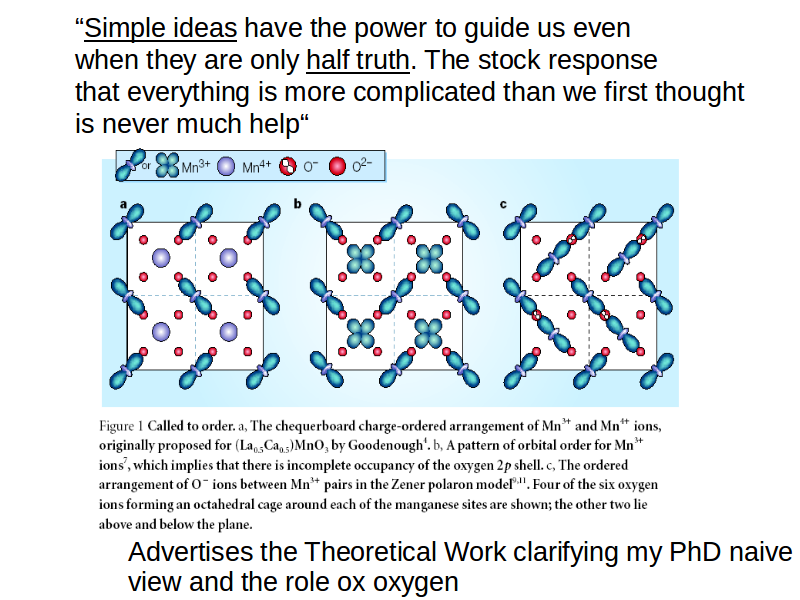
News and view below advertising a largely underrrated Hartree-Fock ab-intio calculations inspired by our ZPO proposal. We think it allow an elegant clarification of the Mn orbital order in the molecular states building the ZP, which help to achieve the readaptation of the Goodenough approach to exchange : the electronic structure batine ab-initio explain why bond valence calculation are inaplicable (it contains only data for Metal / O2- bonds) because in reality, the charge balance is
insured by an O2-/O- order permitting all Mn to keep the same 3+ valence , whereby the remaining electron of O- transmit a ferromagnatic
interaction between Mn associated into Zener pairs.
This theoretical perspective indicate strong local single p-d charge transfer are at play so retrospectively the original wording of the Mn pair as a "Zener polaron", or local double-exchange (DE), being therefore misleading :
oxygen hole formation through p-d charge transfer, could be more
appropriate, as the idea also fits many experimental claims of the
oxygen character of doped holes in manganites. The experimental evidence of an expectred magnetic moment on the oxygen is however lacking because in reality, Mn-d and
O-p states are strongly hybridized in the molecular orbital, and there is full spectrum between
the ab-initio proposal involving Oxygen holes (p-d transfer), and our original proposal (d-d local DE)
Considering Goodenough's original definition
of the ZP, the two possibiities are related to the question of knowing if electrons are still dynamically moving with the Mn pairs, or if they fall into static localised states : our proposal combined to the ab-initio result suggest that the second possibility is fully realised. From there we replace Goodenough critic of Zener assumptions to define the Zener Polaron, by a discussion inviting to doubly criticise Anderson & Hasegawa the other pillar of the early DE theory 1) for having assumed since the start, that oxygen have a closed shell and 2) for not
considering the orbital degeneracy of eg level. Anderson & Hasegawa DE mechanism postulate
the existence of an effective Mn-Mn electron transfer b and assuming that, apply the first order perturbation theory to get the famous, non-Heisenberg b.cos(theta/2) term usable in Mott-Hubbard-type Hamiltonains. Two mechanisms for that transfer b are considered, and for one of them, the effective transfer is calculated using Mn-up / O-2p down / Mn-up states as an excited configuration of the Mn-O-Mn cluster (configuration III, in Anderson & Hasegawa's paper)
Here, by allowing open shell oxygen, we reveal that this exicted configuration could actually be the ground state of the molecular state forming in the system. We hence give a refined and alternatinve version vizualizing Goodenough's rather "hand waving" suggestion ZP formation more completely as an electron localizing mechanism, whereby JT-modes and strong J_H, favor the static molecular orbital formation (the structural/ab-initio view of Mn-dz2
up / O-2p down / Mn - dz2 up state where, in addition to Anderson
& Hasegawa, the Mn level corespond to non-degenerate orbitals lift by the polaronic JT-like distortion): we find in this, a realisisation of the molecular wave function considered in the original Zener proposal, chemically forming a new type of magnetic bond never considered in the manganties which is showing the most unusual concomitant ferro obital and ferromagnetic order of Mn pairs.
Such phenomenology is not contained in modern developement of DE as they all build upon the Anderson Hasegawa model, whihch ignore the Oxygen electronic states.
As well reviewed in Dagotto, in the 90's de Gennes DE theory used Anderson & Hasegawa DE term, and end of the 90's around 2000, DDEX models improved the de Gennes DE model, by including the orbital degeneracy using a DE transfer term that is becoming a complex matrix. The
complex nature of the Mn-Mn transfer in DDEX (berry phase) is what's
giving a (mathematically artificial?) mechanism for spin order induced
orbital order different from the (phenomenologicvally only true and real!) JT effect, associated to topological band insulating behaviour.
What's important in this context, is that the refined idea of ZP
formation restores the idea that orbital ordering in doped manganites (where
DE process is always potentially active),
is intimately associated to JT effect: what we counter intuitively
show, is that the JT effect is not mutually exclusive with DE, but on
the contrary, because they have a common energy scale, the JT effect and DE (or single p-d charge transfer) act conjointly to form localised states : the ZPs. To our knowledge JT-DE coupling is never considered in the manganites. Only their competition is.
ZP PROVIDE AN ENCOMPASSING
HEURISTIC OF CO IN MANGANITES
With this refined
orbitally ordered view of the ZP holding localised molecular orbitals,
the Goodenough approach to deduce Super Exchange coupling from OO is
totally justified: as structurally revealed by the octahedral elongation and the ab-initio result, Mn in this refined conception of the ZP theoretically have a full dz2 orbital order, so they justify the straightforward use of GKA rules explaining the LaMnO3 A-type magnetic structure. Super exchange coupling between the ZP replace and make the rules set for Mn3+/Mn4+ irrelevant.
From
all these consideration, which is the same a the original Goodenough
approach, excepted that it is starting from a different orbital order,
the magnetic exchange topology in the new ZPO scenario got strightforwardly clarified in 2004 in this invisible publication. At this stage, the
strenght of the coupling within ZP's is unknown but expected to be very
strong. That between ZP is F (black and grey bonds) or AF (dashed bond)
with a priori values of the same order of magnitude as that given by INS for LaMnO3 (JF = -0.83 meV, JAF = -0.43 meV)
The combined experimental/theoretical approach closely followinng the original Goodenough approach was bringing therefore an heuristic idea (i.e following the same philosophy as the original Goodenough proposal excepted it assumes OO-ZPs, instead of ionic CO) that's been ignored by ALL the Scientific community.
This crystallographic+ab-initio+GKA inspired NOVEL magnetic/structure correlation related to ZP ordering at half-doping has been cited ONLY twice since its publication in 2004, including one self-citation by myself, which shows
how low has been its visibility, despite the fact I have largely advertised in talks worldwide cumlminating in an....
and shared to anyone interested, is that the heuristic offer an alternative model of magnetic exchange using the GKA rules not only compatible with the low coherence lenght of the CE-state at half-doping but it eventually permit the construction of models at all compositions.
The generalisation of our new Goodenough approach using ZP to
other compositions
than x=1/2, as advocated here, is forming an aternative Goodenough-like Theory, that seems to bring consistency to interpret phenomena beyond half-doping. Especially, in the book "localised to itinerant electron transitions..." Goodenough describes ZPO at x=1/8 as a formation and ordering of ZP with a c-axis (ZPc), but with our heuristic, we can picture this ZP1/8 and reveal how the ZP showing ferro-OO and orbitally ordered Mn3+ ions are coupled by Super Exchange using the GKA provide a microscopic picture of magnetic exchange in one of the most elusive phase of manganites, for which no ionic CO model has good explanation of the magnetism: the Ferromagnetic Insulator state (FI) found at low doping levels.
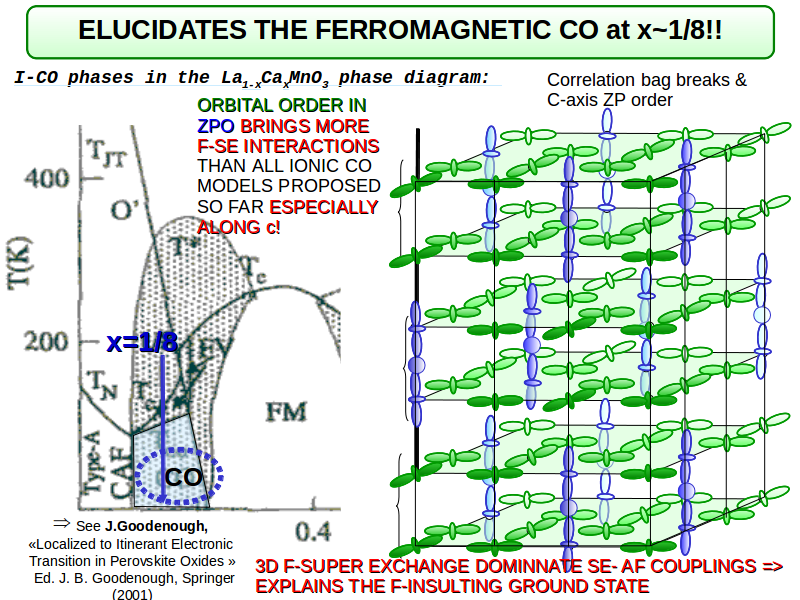
By extrapolations, this is providing an alternative interpretation of phase transitions in PCMO
: there are no report there, of long range CO in the low dopoing range
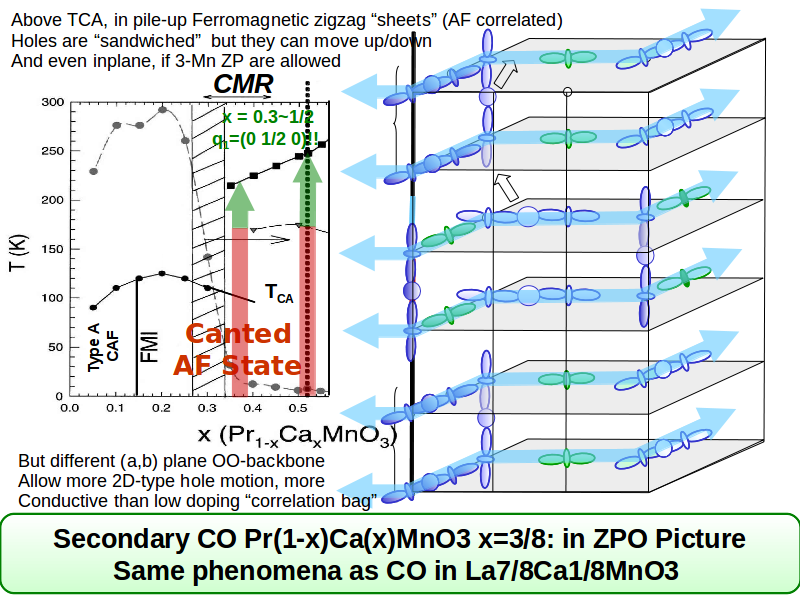
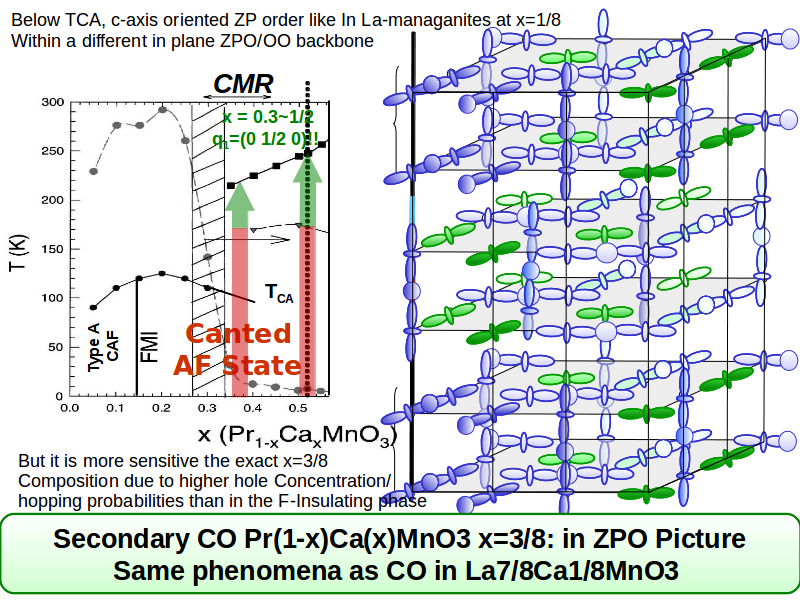
(x<0.3), but there is ONE report which at the time, other groups using TEM told me they have not managed to reproduce, of a secondary CO observed by TEM is happening around T=100K at x=3/8.
THere is no confirmation of the extra modulation by other techniques,
which shows how much this extra/secondary CO is elusive. However from
there, if we assume that the c-axis ZP tendendency to order like in the
ZP1/8 proposed by Goodenough for LCMO and LSMO (around 1/8, from x=0.1 to x=0.2) is
also hapennig in PCMO, the whole phase diagram (between x=0 to x=0.5) can be simply coherently explained by considerning PCMO's lower bandwith compared to LCMO and LSMO.
This lower bandwidth is what is making
the CO tendency due to the formation and ordering of ZPc short range in
nature, yet having a local exchange topology similar to that of the
ideal ZP1/8 model for LSMO. This is what makes the FI state without apparent CO stable in a wider
composition range (about 0.15 to 0.3) in the PCMO phase diagram, compared to the LSMO and LCMO phase diagtrm described by Goodenough. In PCMO, another ZP1/4 is stabilised by the lower bandwidth, which woul also be a ordering of a double number of ZPc.
From there, nobody ever made the following connection : the Tc line of the FI phase in PCMOabove x=1/4 appears to prolongate
within the CO region (0.3<x<0.5), as the reported Tca (canted AF)
ordering temperature. Tc of the FI phase and Tca of the pseudo-CE
state are both related to (more or less short range) ZPc ordering transition, which is suggesting us to build an ideal model for ZP3/8 for the pseudo CE state, starting from the ZP1/2 model with ZPab plane order.
Interestingly, regarding CMR properties, it appear that an equal mixture of ZP1/4 and ZP3/8 corresponds to the composition x=5/16 (about 0.29, in the midst of the dashed region of the phase diagram) close to the optimal CMR: at this composition, this would be because short range ZP1/4 and ZP3/8 ordering tendencies brings about "orbital ordering confusion" in the ab plane, that provoke the complex PS of PCMO30. Those data interpreted with ionic order, can be also interpreted with ZPO: they would manifesty a microstructural patterning alternating about 20-30 Angstrom slabs of the ZP1/4
phase (called ROO reverse orbital order in the paper) and slabs of the
ZP3/8 phase, which correspond to the reported CO phase.
THE FULL HEURISTIC: Largely advertised in talks worldwide until 2005:
a Fully consistent Spin/Struct Correlation of the PCMO phase diagram
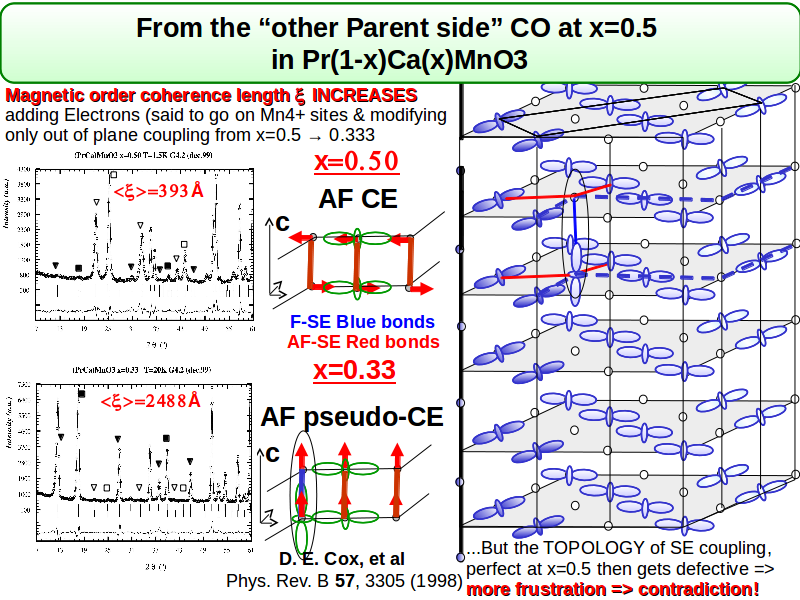
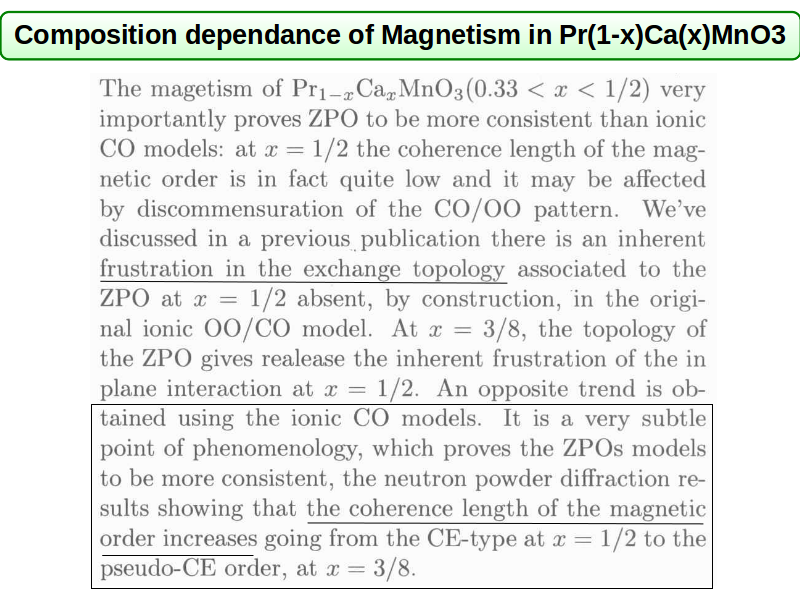
Considering this Key correlation lenght Argument - uniquely understood by ZP models!
far more consistent than the DDEX theory INS rely on...
...relying on made up magnertic phases!
A CONSTRUCTIVEINTERPRETATION
OF INS STUDIES OF MANGANITES
Beyond controversies raised by ZPO, Braden's group INS studies of the CE-state in single layered, and Perring's subsequent work on bi-layered half-doped manganites and ULTIMATELLY, in the study of 3D PCMO50 of the CMR Pr-Ca system, all advocate a modified "Goodenough Model within (justified) by DDEX" shown in Fig 1a of the 3D PCMO50 paper (this model should rather be threrefore called "pseudo DDEX Model"). It is a model copied by Perring from Braden's group : this model is adding long range interactions
(J2 and J3) in the INS model they advocate and ascribed to the
"Goodenough model" (which strictly speakning, consist of 1st neighbor J1
and JAF interaction only. The main conclusion is that DE interactions delocalise electrons, and that is corroborated in the pseudo-DDEX studied, by the value they obtain for J1 (greater than 10mev), and the presence of significant ferromagnetic J3.
Such analysis, rather than proving that the "Goodenough Model" "rule out" ZP model, corroborate important aspects of the ZPO proposal for the ground state of the CE-state : it agrees with the two experimental facts that
are actually challengning the Original Goodenough Model :
the abscence of charge disproponation (corroborated in INS by the
abscence of different moments on different Mn sites) and the CONFIRMATION that the F interaction along the zigzag must contain some form of Double Exchange interaction (Zener mechanism in the ZPO picture, De Gennes type DDEX for INS).
It is commented that the value of the 1st neighbor J1 interaction along the zigzag in the
preferred model (which is similar to the coupling within the ZP in the discarded dimer
models) is actually stronger than ferromagnetic
interaction determined in Ferromagnetic metallic CMR manganites 6-8mev LaCaMnO3. However, authors
do not mention and notice it is also more than 10 times larger than ferromagnetic Super
Exchange in LaMnO3: this is a good phenomenological argument to consider it has NOT a Super exchange origin and has therefore nothing to do with the original Goodenough proposal : the
strengh of this interaction, is the signature of a third interaction
(neither De Gennes DE, nor Goodenough SE) actually justifying ZP
formation along the CE-type zigzags.
This discussion invites to refine the heuristic revision of the DE mechanism considerning ZPs: considering additionally that the value of the F-DE J1 interaction obtained in the CE-state is distinct from (metallic) Double exchange (6-8mev) is interestingly appearing as an average of the strongest F exchange(ZP
formation 10-11 mev) and the F-Super exchange (1-3mev) we suggest that what
we call "DE" in CMR manganites (where it is known that the De Gennes DE is not enough), could be a
dynamical average of vibronic DE process moving O-holes in the Manganites.
The goal of manganites physics is to understand CMR. We believe that the importance of ZP formation has been largely underated. The main reason is because structurally, ZP formation is essentially undistinguishable with small polaron formation and CO
tendencies have been overwhelmingly interpreted with ionic Goodenough
Model that never consider the ZPO as a valid alternative.
Short range CO tendencies of CE-type fragments is ubiquitous in the
PM-phase of canonical CMR La0.6Ca0.3MnO3 type materials. Picturing that phenomenology with ZPO
visually unites various concepts used to describe experimantally
observed short range CO in canonical CMR phases (bipolaron theory,
griffith phase scenario, and experimantal spin and polaron correlations).
We also suggest also to clarify phase separation tendencies and the different CMR observed in the PCMO system
: the macroscopic PS that occur between FI and AF-pCE phase is
restricted to a narrow region around x=0.3, and homogeneous canted
AF-pCE phases betwee x=0.33 and x=0.5. Our interpretation of all our
NPD data, is that Low
temperature CMR in PCMO is PRIMARILY a property of the HOMOGENEOUS pCE
state and NOT only due to F/AF phase separation: in CMR PCMO have an homogeous AF-pCE ground state (0.33<x<0.40), and CMR appear to be due to a 1st order transition between a homogeneous AF state probably having defective versions of the ZP3/8 structure, and the FM phase.