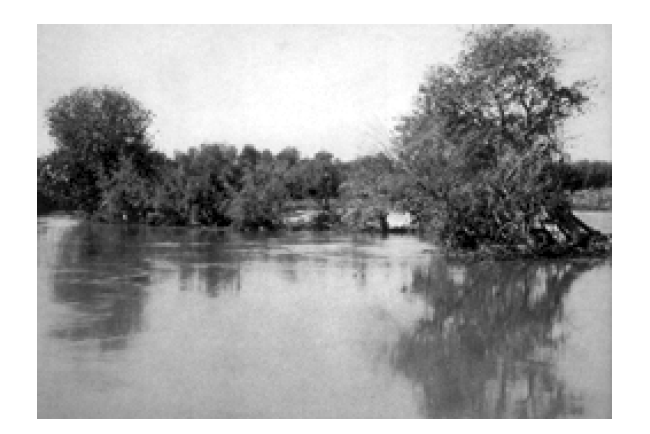
Photograph from the 19C showing the River Jordan overflowing its banks in the springtime
Commentary:
Thank you very much, YYY, for your kind introduction It's a great pleasure to be here and to talk on the challenging topic of whether a scientist can believe in miracles. It reminds me that some years ago I was at Heathrow airport in a thunderstorm so we had to wait before boarding the plane. Eventually we got on the plane and I went to my seat, and then a man came walking down the aisle wearing a “dog-collar” – and for those of you who are from overseas, this is the mark of a clergyman, it’s a special sort of collar. He sat down beside me, and it was still pouring with rain outside the aircraft, and he said to me, “Dreadful weather isn’t it?” I nodded at the truth of this remark and then we took off. The plane climbed through black thunderclouds to start with and then white clouds, until we were above the clouds and the sun was shining down on these cotton wool-like clouds below. The clergyman then turned to me again and said, “There now, it’s turned out to be a wonderful day after all”, and he added, “Isn’t that a miracle?!” So, this evening we’re going to talk about miracles.
I have chosen to talk about three miracles which are representative miracles in different ways. The first one is Moses obtaining water [metaphore of Superfludity!] from a rock, where Moses struck a rock with his staff and water came out so that the thirsty Israelites could drink [the thirst is mankind's Energy!]. In a sense this might be thought of as a minor miracle, because the Bible doesn’t make very much of it, and it is described in just a few verses. That’s an Old Testament miracle, of course.
Another Old Testament miracle I will discuss is the crossing of the River Jordan [metaphore of Luke's fight on the Checkerboard!], where the Israelites are confronted with the Jordan flowing in flood, rushing down and separating them from their promised land [Superfluidity solved!]. Then suddenly this raging river stops [Luke's understanding of the Semi-fluidal: i.e NECESSARY PASSAGE...] and the Israelites are able to walk across the riverbed. This is depicted as a major Old Testament miracle.
Finally, we will consider the Resurrection [Luke's "Written Rock" = Roche Ecrite summer 2013 Vision/Revelations , whch have been finally "came to effect" as the Original call got heard with the attribution of the Nobel Prize in Chemistry to J.B Goodenough! a process that's targetting beyond his knowledge about Supe/Semi-Fluidity, the Core "meaning" of Love!], which is the greatest New Testament miracle of all. These three different types of miracles can be thought of as representative miracles, and before I talk about these let’s look at a definition of a miracle.
First, a popular definition: I obtained it from the Web and this is from a web-based Dutch encyclopaedia called Wikipedia, and it says “a miracle can be defined as a violation of natural law by a supernatural being”. That is probably not a bad popular definition of a miracle, the sort of definition that a man in the street would believe in.
If you go to the Concise Oxford Dictionary then the definition of a miracle there is “a marvellous event due to some supernatural agency”, so this is a somewhat broader
definition which does not necessarily involve a violation of natural law: it may or may not be. I expect that most of us will have our own definition of a miracle but this one is probably the definition which, broadly speaking, most of us would agree with.
What do we mean by the term “Natural Law” which many people believe is broken when a miracle occurs? A simple meaning of “Natural Law” is something that happens in nature, particularly something that happens regularly. For example, we see that the sun rises in the east every morning and sets in the west every evening. That happens regularly and we would be quite rightly astonished if one day this didn’t happen.
At a deeper level than Natural Law is Physical Law, and this is a definition I rather like from a book by the famous Nobel Prize winning physicist (and also renowned bongo drums player!) Richard Feynman, taken from his book called The Character of Physical Law. He says: “There is a rhythm and a pattern between the phenomena of nature which is not apparent to the eye, but only to the eye of analysis: and it is these rhythms and patterns that we call Physical Laws.” These physical laws are more fundamental than what we call natural law, and if we go back to the previous example that I gave, that it is a natural law we see the sun rise in the east every morning and set in the west every evening, then that observation leads us to believe that the sun goes around the earth. Men and women believed this for thousands of years but then the eye of analysis, of Copernicus, came along and said that no, actually the earth goes around the sun. And so physical law is more fundamental than natural law.
Let me briefly digress. When I worked in Oxford there was a scientific discovery reported on the front page of The Times: “The omega minus particle has been discovered by scientists in CERN,” Later that day I met a theoretical particle physicist at Oxford and I asked him just how significant this discovery of the omega minus particle was. He replied that it was an important discovery in a sense, but really it would have been much more important if CERN scientists had not discovered it, because the symmetry of the known elementary particles was such that theoreticians were convinced the omega minus particle must exist from symmetry considerations. They were therefore confident that it would be discovered in the CERN experiments. That conversation reflects what Feynman was talking about, the rhythms and patterns of nature, which the eye of analysis can reveal.
The problem that many scientists have with miracles is not only that natural laws have been broken, but that physical laws have been broken too. A physical law is a theory which has survived many tests so it is very well-established. The problem that many scientists have in believing in miracles – much more than many people who are not scientists – is that they appear to break really well-established physical laws for which there’s a huge body of scientific evidence. We should, of course, remember that scientific laws describe what has happened, and they do not prescribe what must happen in the future. Nevertheless they greatly raise our expectations of what will happen.
The Professor of the Public Understanding of Science at Oxford University, who many will know, is Richard Dawkins, and he wrote an article called “Snake Oil and Holy Water” published in Forbes Magazine on October 4 1999. He said: “The Resurrection, even the Old Testament miracles, are all freely used for religious propaganda, and they are very effective with an audience of unsophisticates and children. Every one of these miracles amounts to a violation of the normal running of the natural world.” The crunch point for Richard Dawkins, and for a lot of scientists, is that miracles seem to be violations of the normal running of the natural world.
Let’s see if this statement of Dawkins, that every miracle amounts to a violation of the normal running of the natural world, is correct by considering the miracle in the Old Testament of water from a rock which is described in just two verses in the Old Testament book of Exodus: “The Lord said to Moses ‘Take in your hand the staff with which you struck the Nile, and go. I will stand there before you by the rock at Horeb. Strike the rock, and water will come out of it for the people to drink.’ [Strike = Understand Superconductors which to date lead to create "Schools of Beliefs!"], to use the words of Dawkins, [Refusing to Belive in Luke and the Author of this text views on Superfluidity <=>] So Moses did this in the sight of the elders of Israel” (Exodus 17:5-6).
I wonder what we think about that short description. Let me make two small points about the text. First, “strike the rock”. The Hebrew word used implies a rather heavy strike. The King James Bible translates this as “smite the rock”, which implies that Moses raised his staff and gave the rock a good thump. The other point which is interesting is that the rock is called “the rock at Horeb” suggesting not a small rock, but a large and maybe a well known rock. So that’s the story, and of course it raises the question of whether rocks can give out water. To those of us living in the UK, I expect our immediate reaction is that this miracle is a scientific impossibility. At first sight, this miracle [Superfluidity remains NOT UNDERSTOOD to date => has lead to create "Schools of Beliefs!"], to use the words of Dawkins, [Refusing to Belive in Luke and the Author of this text views on Superfluidity <=>] “violates the normal running of the natural world.”
Let’s think scientifically about this. For a rock to give out water it has to be able to store water and so it has to be porous. Porous rocks exist, for example, sandstone and limestone, which can absorb huge quantities of water from rain. In fact when they are underground we use them as aquifers, natural reservoirs of water, and we sink wells and boreholes into them to extract the water.
I was at Liverpool University before coming to Cambridge University and lived in a place called West Kirby, in a house built on the side of a sandstone hill. The back garden rose up steeply and there was a sandstone cliff about ten or twelve feet high which had been cut through in Victorian times. Hours after a rainstorm had finished, water would still be flowing out of this rock. So water can be stored in these porous rocks, but if they are above ground in England, the water is not kept in, it flows out. However if you go to a desert region, rocks weather in a rather different way from in England because of sandstorms, which at high speed sweep sand and organic matter from decaying plants and animals on to the rocks. Over time, rocks in the desert can develop a hard impervious crust, a bit like cement, and this is due to weathering. Modern Bedouin call this hard crust “desert varnish”, and it provides a smooth surface for their rock art. If the crust of a porous rock is broken by a sharp blow, water can indeed flow out and this is an effect which is well known to hydrogeologists.
Bob has mentioned my book “[...]” so I will read out an interesting quotation from it – this is by a former British governor of Sinai, Major Jarvis, who wrote a book called Yesterday and Today in Sinai in 1936. He says: “The striking of a rock at Refadim by Moses and the gushing forth of water sounds like a veritable miracle but the writer (Major Jarvis) has actually seen it happen. Some of the Sinai Camel Corps had halted in a wadi [a dried up river stream] and were digging in the loose gravel accumulated at one of the rocky sides to obtain water that was slowly trickling down through the limestone rock. The men were working slowly and the Colour Sergeant said “Give it to me” and, seizing a shovel from one of the men, he began to dig with great vigour. One of his lusty blows hit the rock, when the polished hard face that forms on weathered limestone cracked and fell away exposing the soft porous rock beneath, and out of the porous rock came a great gush of clear water. It is regrettable that the Sudanese Camel Corps hailed their non-commissioned officer with shouts of ‘What ho, the prophet Moses!”
So you see that when we look at the water from the rock miracle scientifically it does not “violate the normal running of the natural world,” and a similar event is well documented. To bring matters right up to date, I happened to be searching the Internet and I found this Associated Press report dated Wednesday 25 February 2004 – so this really is up-to-date – “NASA Rover Drills Martian Rock for Water. The six-wheeled Rover used the rock- abrasion tool on its instrument-tipped arm to grind a fraction of an inch into the surface of a rock called “El Capitan”. The rock’s weathered surface was ground away, so that the Rover could examine the material underneath.”
Let us return to the biblical account of Moses giving the rock a hard blow, a blow that was no doubt sufficient to crack the surface crust. The expression “the rock at Horeb” is a strange statement to make because if you go to the traditional Mount Sinai, or to any of the other sites which have been proposed as the site of Mount Sinai, you’ll find there are many rocks scattered around, so to make sense, “the rock at Horeb” suggests a large well-known rock. My own site of Mount Sinai is Mount Bedr in Saudi Arabia. Mount Bedr is a volcano which stands on top of a large sandstone table mountain called Tadra, which has a diameter of six miles. I think it may be the largest table mountain in the world – it’s bigger than the famous Table Mountain in Capetown, South Africa. Just think of the water storage capacity of a sandstone mountain six miles across. I suggest that is the rock at Horeb, if my location of Mount Sinai is correct.
So was Moses obtaining water from a rock a miracle? What we have seen is that water coming from a rock violates no natural laws. The biblical story fits what we know from science. In particular, Moses struck the rock to break the crust and “the rock at Horeb” implies a large rock which could have contained much water. The event could have been lucky timing, of course, or it could be a miracle of timing with God working in, with and through nature. From an isolated event such as this, it is difficult to say whether this event was more than “lucky chance”. I will come back to this later.
Let us move now to another miracle: the crossing of the River Jordan. This is described in the Old Testament book of Joshua as follows: “Now the Jordan is in flood all during harvest. Yet as soon as the priests who carried the Ark reached the Jordan and their feet touched the water’s edge, the water from upstream stopped flowing. It piled up in a heap a great distance away, at a town called Adam in the vicinity of Zarethan while the water flowing down to the Sea of the Arabah (the Dead Sea) was completely cut off. So the people crossed over opposite Jericho” (Joshua 3:15-16).
Let’s try and picture what the author is describing. He’s saying that the River Jordan was not flowing normally, it was in flood, implying that it was a wide, raging torrent. The Israelites were on one side, on the east of the River Jordan, and they wanted to be on the other side, the land of Canaan, on the west of the Jordan. They had waited for about forty long years to enter Canaan and, tantalizingly, they could now see this Promised Land but the situation looked hopeless because they were separated from it by this raging river. Then suddenly the water stopped flowing: it was as if someone had turned off a giant tap and cut off the water supply, and the Israelites crossed the river bed in triumph.
Well, I wonder what you think of that story. I’m sure many of you will think “what a wonderful children’s story”, or, “what a fabulous fairy tale”. That’s a very reasonable reaction because the story seems incredible. We know from our own experience that rivers do not suddenly stop flowing, particularly when they are in flood. Most people, including most biblical scholars, believe this remarkable story to be a legend.
When I read this story I was struck by a curious detail in it. All of you will know that in good detective stories where there’s a difficult mystery to be solved, it’s the minor clues that are important. The major clues provide the framework of the solution but the minor clues hold the key. There is a curious detail, a minor clue, in the story of the crossing of the River Jordan which I found fascinating, so let’s look at the passage from the book of Joshua again. If I – and I believe most people – had been inventing this story, I would have said, “The Israelites stood by the water’s edge and the river stopped where they were.” But the story doesn’t say that, it says that the water piled up in a heap a great distance away. Isn’t that curious? To emphasise this point, the writer goes on to specify precisely where it stopped, at a place called Adam, and then in case readers didn’t know where Adam was, the writer says it’s in the vicinity of Zarethan. The writer really is emphasizing that the water didn’t stop where the Israelites were, but a great distance away upstream. If the story was made up, or a legend, then that’s an extraordinary and unlikely detail to put in. So the water stopped flowing not at a town called Alice, but at a town called Adam, and whether or not you’re a scientist, the obvious question to ask is why? What stopped the water flowing at Adam [ADA-M is one of the Names of Luke/Aladinsane who knows how Balls = electrical charges stop flowing in Zig Zag fashion within Semi-fluidal Crystals : it is a metaphore of his BRAIN = desert Mind!!] , and can we find out, three thousand years later?
To investigate further we first need to look at the geography of the Jordan crossing. Note the careful attention the writer gives to the geography of the crossing, so when he says that the Israelites crossed the Jordan, he specifies that it was opposite Jericho. He doesn’t just say the water stopped flowing a great distance away, he says it stopped at Adam in the vicinity of Zarethan. Then, just for good measure, he says all these places are upstream from the Dead Sea, so the writer is clearly trying to root not only in history but also in geography where these dramatic events happened. The problem we face today is that most of the place names in the Exodus story have long disappeared or changed, and that of course is not surprising because the Exodus happened over 3000 years ago. Some names, such as Jericho, have survived, but most have not. Place names keep changing, of course. For example Bombay in India is now called Mumbai. So if you look at a modern map of either Israel or the state of Jordan you will find no town called Adam. Can we find ancient Adam after 3000 years?
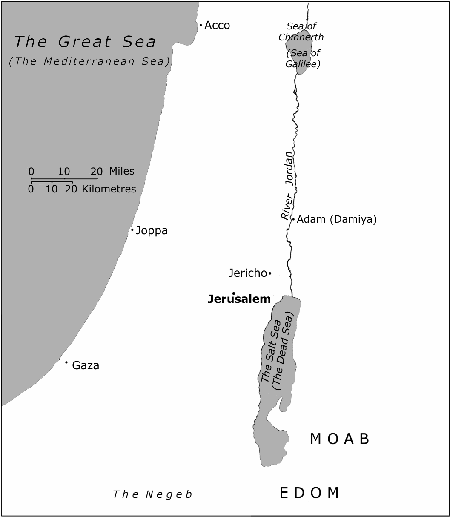
Map showing the location of the River Jordan and Adam
In common with a number of other ancient languages, in ancient Hebrew the written text consisted only of consonants. So that these written words could be read, vowel sounds had to be used, and we’re going back to that situation today. Those of you who use text messages in mobile phones (cell phones) will know that if you want to write “text”, to save time you write “txt” and the reader knows from the context and from experience that ”txt” means “text”, not “tixt”, or “toxt”, or “taxt”. In the original Hebrew text Adam would have been written as the consonants ’dm, where the mark ’ is a breathing sound. When modern Arabic words replace ancient Hebrew words, certain linguistic patterns emerge, and people who have studied these languages are familiar with these patterns. For example, if the Hebrew word began with the breathing sound ’, then in Arabic that’s usually dropped and an Arabic ending is added, but the consonantal core remains. So if we want to look for the ancient Hebrew name Adam on a modern map, then we should look for a name containing the consonants dm, to which an Arabic ending may have been added. If you look on modern maps you’ll find higher up on the River Jordan, about 17 miles north of Jericho, there’s a place called Damia, which has the consonants dm and adds an Arabic ending. Many scholars agree that ancient Adam is modern Damia. However, can we prove it? I should mention that earlier I said that no modern map showed the place Adam but I have found one modern map, the Bartholomew World Travel Map of Israel and Jordan, which marks the place Damia, and writes in brackets after it, “Adam”, so that map recognises the equivalence of these place names.
To explain the geography further, the Israelites had travelled up on the east side of the Dead Sea and were on the east bank of the River Jordan, opposite Jericho. Damia can be spelt in different ways because Arabic people write down words as they are pronounced, so Damia is sometimes spelt Damiya (or Damiyah). Can we prove that ancient Adam is modern Damia beyond reasonable doubt? This is where the science comes in. On 11 July 1927 there was a well-documented earthquake which shook Jericho. Buildings collapsed, walls collapsed and cracked, and this earthquake was detected in places as far apart as Europe, the USA and Russia on seismographs. This particular earthquake was 6.5 on the Richter scale. For comparison, you may remember the earthquake in Kobe, Japan in 1995, which killed 5000 people. This was 7.2 on the Richter Scale. The earthquake in San Francisco, which partially collapsed the San Francisco-Oakland Bridge and killed 62 people, was 7.1 on the Richter Scale. So the 1927 earthquake that shook Jericho was not as strong as these other earthquakes but nevertheless it was a substantial and significant earthquake. The earthquake arose because of a geological slippage along a fault known as the Jericho Fault, which runs north-south along the River Jordan which is itself part of the Great Rift Valley. There are two tectonic plates involved, one on each side of the River Jordan, which move relative to each other, and it’s this slippage that has created the Great Rift Valley.
A number of people have studied this earthquake, particularly Amos Nur, who is a well-known Professor of Geophysics at Stanford University and I wrote to him about this earthquake. He replied to me as follows: “During the 1927 earthquake, several ground cracks appeared, together with an outpouring of ground water. This soil liquefaction phenomenon has been well observed in earthquakes elsewhere. During the earthquake, mudslides occurred along the Jordan near Damia, about 30 kilometres [eighteen miles] north of Jericho. These temporarily stopped the river’s flow.”
Professor Nur is saying that in 1927 there was an earthquake which gave rise to mudslides, near Damia, precisely the place which we believe to be ancient Adam, and these mudslides temporarily stopped the flow of the River Jordan. Have similar mudslides occurred previously? Nur continued in his letter to me: “Adam is now Damia, the site of the 1927 mudslides which cut off the flow of the Jordan. Such cut-offs, lasting typically one to two days, have also been recorded in 1906, 1834, 1546, 1534, 1267 and 1160. The stoppage of the Jordan is so typical of earthquakes in this region that little doubt can be left of the reality of such events in Joshua’s time.” Notice that the river is typically cut off for one to two days. The water of the Jordan piles up behind the mudslide and either has to come over the top of it or divert around it.
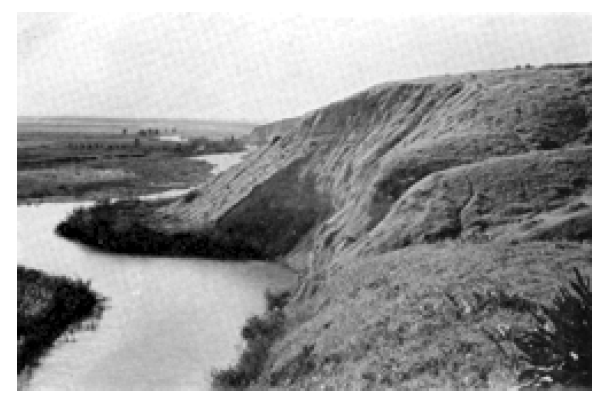
Landslide off the bank
of the River Jordan in 1957.
This
landslide almost completely cut off the flow of the River Jordan
The photograph above shows a mudslide near Damia which almost, but not quite, stopped the Jordan. This was taken in 1957 and it shows the Jordan flowing around the mudslide. This mudslide was again caused by an earthquake – if it had been more substantial it would have totally blocked the river. Was the crossing a miracle? We have seen that there is a natural mechanism, an earthquake induced mudslide, that can explain the crossing of the Jordan. The waters of the Jordan piled up behind the mudslide and then broke through, typically one or two days later. We have also said that linguistically we can identify ancient Adam with modern Damia and in more modern times Damia is the place where these well-documented earthquake-induced mudslides have happened. So we have a consistent story. We can give a scientific explanation of the Jordan crossing, however, the Old Testament regards this as a major miracle of God. Can we reconcile these two viewpoints? [Yes if the Old Testament PREDICTED the Propecy of ADA-M, since it happens to be the Acronym of Aladinsane. Aladinsane knows how Balls = electrical charges stop flowing in Zig Zag fashion within Semi-fluidal Crystals : those are therefore a metaphore of his BRAIN = desert Mind! God has "coded" the "Map" in the Bible inspired by the surrounding Geography but using names certainly more often "metaphorically" than "exactly"!]
First, we need to ask how the ancient Israelites thought about events in the natural world such as earthquakes. Nearly every ancient civilisation had many gods: for example the Egyptians had one god who controlled the rain, another who controlled the annual flooding of the Nile, another who controlled the rising of the sun, yet another the rising of the moon, and so on.
Ancient Israel had one God who, as it were, encompassed all of these other gods. Their God controlled all the forces of nature. So if an earthquake caused the Jordan to stop, I believe the Israelites would have regarded this as just as much the hand of God as if he’d clicked his fingers, or sent an angel, because they believed their God was in charge of the natural world. The Israelites regarded the stopping of the River Jordan as a miracle because it happened at just the right time. So just as the Israelites were standing on the water’s edge, needing to cross the River Jordan to get to the Promised Land, the earthquake-induced mudslide occurred.
If you doubt this explanation, let me read you a passage from the Old Testament book of Psalms. It’s part of Psalm 77 and I think it is a remarkable passage. The Psalmist writes: “You are the God who performs miracles; you display your power among the peoples… Your thunder was heard in the whirlwind, your lightning lit up the world. [Note that the psalmist writes your thunder, your lightning] The earth trembled and quaked [here’s the earthquake]. Your path led through the sea, your way through the mighty waters, though your footprints were not seen. You led your people like a flock by the hand of Moses and Aaron” (Psalm 77:14-20). This passage is clearly referring to the Exodus because it explicitly mentions Moses and Aaron. However, it seems to me that the Psalmist is regarding events like thunder, lightning, earthquakes, the crossing of rivers and seas as all being the handiwork of God. And he adds this wonderful phrase, “Though your footprints were not seen.” In other words God didn’t come down and leave his footprints in the mud of the Jordan riverbed, or leave behind a celestial visiting card saying “I was here”, he performed his miracles using natural events and the Israelites saw them as the handiwork of God.
Here’s another example of a miracle – unfortunately we won’t have time to consider it in detail: the crossing of the Red Sea. The book of Exodus says: “Moses stretched out his hand over the sea, and all that night the Lord drove the sea back with a strong east wind and turned it into dry land.” The Bible is explicit that there was a natural mechanism for this miracle: a strong east wind. So again we’ve got another remarkable miracle of timing.. The Jordan was stopped just when the Israelites arrived on its bank, and the Red Sea was driven back just when the Israelites were trapped there by Pharaoh’s army.
The idea I am suggesting here, that many biblical miracles were natural events, but that the timing was miraculous, is not new of course. Aristotle wrote about miracles and he said that the “efficient cause” of a miracle could be a natural agent, with the “final cause” being the will of God. The miracle is revealed by the extraordinary timing of the event [The Political transition, in the World, between the last Centiury Dogma, that Hope would be a priori brought by Liberalism/Democracy, and the fact Democracies since ~2010 promote and see within their own Domain, the rise of Fears, discriminations, as testified by the rise of D. Trump, Brexit, etc...].
Let us try to picture the scene of the Jordan crossing again. The River Jordan is not now very impressive because since 1940 large quantities of water have been taken from it by both Israel and Jordan for irrigation, and so the River Jordan is now a shadow
of its former self. The Old Testament Book of Joshua says the Israelites crossed the Jordan in the spring, on the tenth day of the first month (Nisan) and that corresponds to March or April in our calendar. The main source of the Jordan is the snow-capped Mount Hermon, though there are a few other sources: the snow melting in the spring causes the river to flood. So when the book of Joshua says that the river was in flood, this is consistent with it being springtime.
There was a British expedition to the Jordan in the nineteenth century, before any river water had been removed for irrigation purposes, and they found that the Jordan in flood was half a mile wide. So what we see now as the River Jordan is quite different from its width in ancient times. The river the Israelites crossed would have been a real barrier to them and I suggest that after three thousand years we have been able to reconstruct how and where the crossing occurred. Here is a rare photograph of the River Jordan in flood taken in the nineteenth century (figure 2). Trees and bushes normally on the bank of the river are clearly submerged by the flood waters. This was the river the Israelites crossed.
There are many miracles in the Exodus story which I believe have scientific explanations. There’s the burning bush, the ten plagues, the pillars of cloud and fire, the crossing of the Red Sea, turning bitter water sweet, water from a rock, and crossing the Jordan. I think all of them were probably natural events that modern science can explain and I give these explanations in my book The Miracles of Exodus. So I believe no scientific laws are broken in these miracles. I suggest any of them taken individually could be lucky chance, because lucky chance events certainly happen. But what happens in the Exodus story is you have event after event after event which occurs at just the right time and I do think that strongly suggests a “final cause”.
Let me give you a simple example. About a year ago I noticed in my house that after I’d had a shower in the bathroom upstairs, about three hours later there was a wet patch on the kitchen ceiling below. I thought that’s just a coincidence. If I have a shower and there’s some sort of leak, a patch should appear on the ceiling below within about fifteen minutes, not three hours later. So I thought the events were not related, and the patch dried quickly. I had another shower and, a few hours later, there was again a wet patch on the kitchen ceiling. And I still thought it extremely unlikely that it would take three hours for a water leak from the shower to come through. When the same thing happened a third time, however, I knew it wasn’t just chance and there must be a causal relationship between my taking a shower and the wet patch on the kitchen ceiling. Indeed there was and I found the leak. It turned out to be a tortuous path from the leak to the kitchen ceiling and that’s why the water took three hours to come through.
Here is a quotation I very much like from a Dutch scientist, Professor Reijer Hooykaas, in his book Religion and the Rise of Modern Science: “The scientist, even when he is a believer, is bound to try as far as possible to reduce miracles to regularities: the believer, even when he is a scientist, discovers miracles in the most familiar things.”
Let me move on to the Resurrection and ask the key question, can science explain the Resurrection? I think it’s clear that with our present scientific knowledge it cannot, and I suspect it probably never will. I have to be very careful about saying that of course, because science today is so much more powerful than science was one hundred years ago – so it is difficult to predict what events science may be able to explain in another hundred years’ time. But even so, the Resurrection seems to override so many fundamental physical laws that it’s my guess that it probably never will be explicable by science. I may be wrong here [Yes, in the Sense the only considered Resurrection is that of a BODY - overlooking the fact that in Mankind - "Soul Particles" = Idea - Like Luke also Live and Die...], but it looks to me as though natural laws [applying to BODIES] are being overridden in the Resurrection [but not in Phenomena - Para normal - where Psychological Science Rules].
Overriding natural laws not only give scientists a problem but also theologians, and the reason for this is that the picture of God given in the Bible is of a consistent God. There are many biblical passages where the consistency of God comes through strongly. So theologically, if God created the Universe and is constantly upholding it, and if God is a consistent God, then would he override the laws he has established? Let me give you a musical analogy which may be helpful. Imagine you are standing behind a pianist who is playing without music and you are watching the pianist’s fingers. Every time the pianist goes to play the note “F” he plays “F sharp”. You can deduce from this the key signature of the music. The key signature is the rule the composer establishes for playing that piece of music. If you keep watching you may observe that, on occasion, when the pianist should play “F sharp” he plays “F”, or he may play black notes when you expect him to play white ones. These are what musicians call “accidentals” which the composer has deliberately put in the music. The composer, of course, is free to put accidentals in the music – he is the composer – and although he’s set up a key signature which signifies the way the music should normally be played, he is free to say that it should be played differently on occasions. If he is a great composer, the accidentals will never be used capriciously, they will always make better music. It is the accidentals which contribute to making the piece of music great. The analogy with how God operates is clear. God created and upholds the universe but, like the great composer, he is free to override his own rules. However, if he is a consistent God, it must make more sense than less for him to override his rules. It is interesting to see how the Bible portrays the Resurrection. Peter speaking on the day of Pentecost, exactly seven weeks after the Resurrection, says, “God raised him [Jesus] from the dead because it was impossible for death to keep its hold on him” (Acts 2:24). Peter is saying that if Jesus really was the Son of God, then the Resurrection was inevitable and not incredible. It was more consistent for the Resurrection to occur than for Jesus to remain dead, if Jesus really was the Son of God
Let me give a final tentative thought on Feynman, and the nature of physical laws. Feynman talks about the rhythms and patterns of nature we call physical laws. These physical laws provide the framework we use to describe how the universe operates. The great astronomer, Kepler, once said that scientists are trying to think God’s thoughts after him, so scientists look for the regularities in the universe and from these they formulate physical laws, which describe how the universe operates. It seems to me that within this framework of regularities [Physics/Maths] there are inherently very rare irregularities [Nature!].
[e.g] In my research I work with crystals [note: the authors gave up on Superfluidity inj 1998, but always had interest in Semiconductors] and these have defects in them. In fact crystals are rather like people – it’s the defects in them which tend to make them interesting. Most crystals contain a large number of defects. However, single crystals of silicon can be grown virtually defect free, with no dislocations or stacking faults in them, and virtually no impurity atoms. The silicon single crystal is then an almost perfect periodic array of atoms. However it is not totally perfect: at room temperature there is one vacant atom site in every 10^12 atoms. These vacancies are there for thermodynamic reasons, because although a vacancy increases the internal energy of the crystal, it also increases the entropy, and the free energy goes down. At first sight we have a perfectly regular periodic array of atoms, but when we look closely we find one vacancy every 10^12 atoms at room temperature. Somewhat similarly, at first sight DNA replicates perfectly, but on a closer look there are rare defects or mutations in the replication, and these mutations [Nature/Randmness] give rise to the rich variety of life that we have. I suspect that these sorts of rare irregularities in silicon and DNA occur in the universe everywhere you look, if you look sufficiently closely. Hence I suspect that the rhythms and patterns in the universe are not quite as regular as the Feynman statement implies, and it may be that these rare irregularities are critical to the way the universe operates [Not the Mathematical Singularities, which are (rather dangerous fascinating) Abstractions = Defying Human Conceptions/Limits, in the W. Blake's Sense of the Poetical Genius]. I put this forward as a tentative thought. But now let us return to the subject, “Can Scientists Believe in Miracles?”
I suggest that some miracles, the Resurrection for example, are like accidentals on a music score, in which the Great Composer is overriding the normal way the universe operates. A mathematical analogy may be helpful. It seems to me that a miracle like the Resurrection is similar ["Similar" meaning that their effect slightly DIFFERENTLY] to mathematical singularity in space and time [and the Conception of "Space/time" in Physical/Natural Phenomena]. I suggest that miracles like the Resurrection are like a local singularity [but that is not Mathematical: it happens in the "Psyche", i.e how the Soul concieves the "World around"...] in which God chooses to operate the laws of nature differently at that point in space and time [including our inherently irrational Human Dreams!]. I believe it is rare for God to locally override physical laws and perform a miracle such as the Resurrection. I believe most miracles are miracles of timing in which no scientific laws are overridden [... or overriden! by what's in fact yet very little known effects of para-psychology...]. So to answer the question “Can Scientists Believe in Miracles?” I suggest the answer is “Yes” [<=> Belive in the EQUIVALENCE (atemporal acausal force binding) DREAMS/REALITY]. Thank you.